
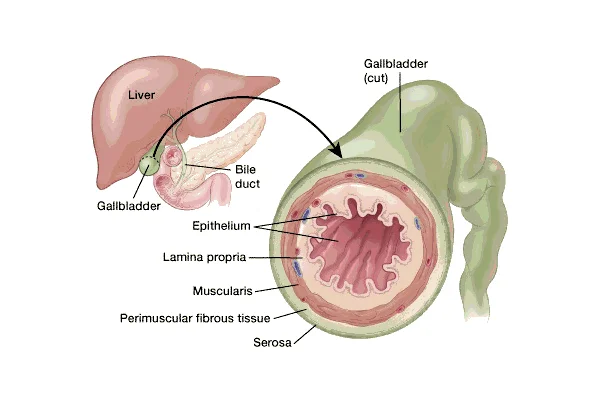
| Category | Carcinoma GallBladder |
Gall Bladder – Do Not ignore?
Gall Bladder is a pear-shaped organ present below the liver adjacent to the pancreas. Though not a vital organ, it performs an extremely important role in fat digestion by secreting bile. Bile is the thick viscous yellow fluid containing various chemicals and cholesterol compounds required for fat digestion. The cholesterol is present in a delicate balance to keep it soluble. The disturbance in this state of balance results in crystallization which gets deposited in the wall of the gall bladder. These crystals may increase in size to result in the formation of stones.
The stones may be as small as sand particles to as large as a tennis ball. The stone may be single to hundreds of them packed in the gall bladder. These stones may remain innocuous for years or may cause problems. The stone may become painful causing pain in the upper abdomen mainly on the right side which is typically intermittent and recurrent (Described as biliary colic). The stone may slip into the bile ducts causing jaundice and infection. The stone may get stuck into the pancreatic duct causing pancreatitis.
Various treatment options have been explored and tried in the past including medications for stone dissolution but none have stood the test of time and result in failure and stone recurrence. The treatment option for the stone disease is surgery (cholecystectomy) which nowadays is done laparoscopically in most patients. Laparoscopic surgery also called keyhole surgery is done by small incisions resulting in less pain and faster recovery.
Another disease group of the gall bladder is the Cancer of the Gall Bladder. This, although can occur in any person, is seen more commonly in females. The disease has a large geographical variation and is seen more frequently in north India compared to the south. An interesting association seen with Gall Bladder Cancer is its association with gall stones which are seen in 90% of the patients. Although not all gall stones go on to develop into cancer. It is a dreaded disease if not diagnosed and treated on time.
The cheapest and the simplest test to diagnose gall bladder diseases is Ultrasound. Gall Bladder may not be the hero of the digestive tract but if mishandled can lead to devastating problems and complications.
Carcinoma Gall Bladder
Carcinoma Gall Bladder or Cancer of the Gall Bladder is one of the common cancers in India, especially in North India. Most of these cancers are associated with Gall Bladder stones, although gallstones, to date, have not been found to be the cause of gall bladder cancer. Most of the patients when they consult the doctor are advanced with a very low possibility of any cure. The initial symptoms are vague and non-specific which results in the delay to seek any advice and treatment.
The initial symptoms may include vague pain in the upper part of the abdomen(tummy), abdominal fullness, and early satiety. These may be infrequent and often relieved with common medications thereby delaying any proper medical advice. Other symptoms may be Inflammation of the gallbladder like pain in the right side of the abdomen associated with vomiting or fever. When the disease is in the advanced stages, the patient may have jaundice, mass felt in the abdomen, recurrent vomiting, or abdominal distension.
Diagnosing Gall Bladder Cancer
The fact that needs emphasis is a high index of suspicion is required to diagnose. The ultrasound is the initial investigation that will pick up the clear cases. A good radiologist and surgeon will identify the subtle features to suspect a possibility of cancer in doubtful cases.
CT scan or CAT scan is the next investigation that will settle the diagnosis in most cases and help the surgeon to decide the stage of the disease before proceeding for surgery. Other investigations like MRI or MRCP, PET Scan may be required in certain specific situations depending upon the reports of the previous investigations.
Gall Bladder Cancer- The diagnostic dilemmas
Situations may arise where, even with all the investigations, it may not be possible to determine the diagnosis. This happens because cancer of the gall bladder may present in similar ways as inflammation of the gall bladder (Cholecystitis). In these conditions, the CT scan may also fail to differentiate the two conditions with certainty.
In these conditions, a more dreadful condition (Gall Bladder Cancer) is assumed and treated accordingly. The confidence to proceed in this way has gained greater acceptability with advanced laparoscopic surgery (keyhole surgery).
Gall Bladder Cancer- The unwanted situation (Incidental Gall Bladder Cancer)
The incidental gall bladder cancer is the situation when cancer is the surprise diagnosis after the surgery of the gall bladder revealed on the biopsy report. The situation is not rare but rather uncommon. The condition requires further evaluation by the surgeon. This includes a review of the previous investigation reports, operative records, and some fresh investigations. After a proper and complete evaluation, nothing additional may be required for a lucky patient if the disease was in the early stages. Else, the patient may have to undergo a repeat surgery for cancer.
Gall Bladder Cancer- Treatment
After all the required investigations, if possible, the only treatment having the potential to cure the disease is surgery. During surgery, the gall bladder together with a very small portion of the liver and surrounding lymph nodes is removed. With the advent of advanced laparoscopic surgery, this is feasible laparoscopically as well. In certain cases, when the tumor is large, a large part of the liver may have to be removed. For patients, where the tumor is too large to be excised, initial chemotherapy is given to reduce the size of the tumor and make it operable at a later date. For tumors that have already spread beyond the domains of surgery, chemotherapy is the treatment required.
Gall Bladder Cancer- Complications
Complications may occur in any disease and the gall bladder is no exception to it. The patient may develop jaundice that may occur due to the involvement of the bile duct. Such a condition was considered to be a criterion for inoperability. But today, even such patients may be amenable to curative surgery. Earlier such patients required palliative surgery to bypass the bile duct in order to relieve jaundice. Today, after all the evaluations, some patients who are considered to have advanced disease and not feasible for a surgical cure, do not require surgery for relieving jaundice. Jaundice can now be relieved by endoscopic methods.
Another complication of great importance is obstruction of the food passage due to large disease. This too can be relieved by endoscopy and placement of a stent. In the past, this too required a surgical procedure to bypass the food passage.


